06 — Within-child variability: do consistency measures cohere, and change with age?
ImportantAI-generated — not for publication
The code and prose in this chapter were written by Claude Code (an AI coding agent) under human direction. They have not been line-by-line verified by a human and must not be published or cited as-is.
WarningPreliminary & unvetted analysis
These are exploratory analyses of preliminary, in-progress LEVANTE data. Results have not been reviewed or validated and require checking by the LEVANTE Data Coordinating Center before any use.
The question
A central LEVANTE aim is to extract information about variability within children, not just their average ability. A child’s consistency — moment-to-moment, response-to-response, wave-to-wave — may itself be a stable, meaningful individual difference (and is theorized to index attentional / executive control and developmental stability).
This notebook is an exploratory first pass. We extract three naive per-child, per-task variability indices, then ask:
Do the variability measures hang together within a child? (Is a child who is variable on one task / one index variable on others — a general “trait”?)
Following the brief, we start with naive estimators and treat their reliability as a first-class result — if a naive index is too noisy, that is the signal to move to model-based estimation.
For each task we load trial data once and compute, per run: RT-IIV (SD of log-RT on correct trials), and infit person-misfit using the published item parameters (Rasch/2PL; joined within language for the by-language tasks) and the child’s final ability θ̂. Split-half reliabilities (odd/even trials, Spearman-Brown) tell us whether each naive index is stable enough to interpret.
Code
sb <-function(a, b){ r <-cor(a, b, use ="complete.obs"); 2*r/(1+r) }extract_task <-function(tid){ rn <- runs |>filter(task_id == tid) tr <-load_levante_trials(task_ids = tid) |>filter(run_id %in% rn$run_id, !is.na(correct)) |>left_join(rn |>select(run_id, theta, language), by ="run_id")# join item parameters (within language for by-language tasks) ipx <- ip |>filter(task_id == tid)if (tid %in% bylang) { tr <- tr |>inner_join(ipx |>transmute(language = subset, item_uid, b = difficulty, a = discrimination),by =c("item_uid","language")) } else { tr <- tr |>inner_join(ipx |>transmute(item_uid, b = difficulty, a = discrimination) |>distinct(item_uid, .keep_all =TRUE), by ="item_uid") }# IRF must match the scoring model: the fitted mirt models carry a FIXED# guessing asymptote at each item's chance level (g = chance, est=FALSE), so# the person-fit response function is P = c + (1-c)·logistic, not plain logistic. tr <- tr |>mutate(c =ifelse(is.na(chance), 0, chance),irf =1/(1+exp(-a*(theta-b))),P =pmin(pmax(c + (1-c)*irf, .001), .999),w = P*(1-P), r2 = (correct - P)^2)# run-level indices iiv <- tr |>filter(!is.na(rt_numeric), rt_numeric >200, rt_numeric <30000, correct ==1) |>group_by(run_id) |>filter(n() >=10) |>summarise(iiv =sd(log(rt_numeric)), meanlrt =mean(log(rt_numeric)), .groups ="drop") infit <- tr |>group_by(run_id) |>filter(n() >=10) |>summarise(infit =sum(r2)/sum(w), .groups ="drop") idx <- rn |>select(run_id, user_id, short, theta, age) |>left_join(iiv, by ="run_id") |>left_join(infit, by ="run_id")# split-half reliability sh_iiv <- tr |>filter(!is.na(rt_numeric), rt_numeric >200, rt_numeric <30000, correct ==1) |>group_by(run_id) |>filter(n() >=12) |>mutate(h =row_number() %%2) |>group_by(run_id, h) |>summarise(v =sd(log(rt_numeric)), .groups ="drop") |>pivot_wider(names_from = h, values_from = v, names_prefix ="h") sh_inf <- tr |>group_by(run_id) |>filter(n() >=12) |>mutate(h =row_number() %%2) |>group_by(run_id, h) |>summarise(v =sum(r2)/sum(w), .groups ="drop") |>pivot_wider(names_from = h, values_from = v, names_prefix ="h")list(idx = idx,rel =tibble(short = core$short[core$task_id == tid],n =nrow(idx),iiv_rel =if (nrow(sh_iiv) >3) sb(sh_iiv$h0, sh_iiv$h1) elseNA,infit_rel =if (nrow(sh_inf) >3) sb(sh_inf$h0, sh_inf$h1) elseNA))}ex <-map(core$task_id, extract_task)index_runs <-map_dfr(ex, "idx")rel_tab <-map_dfr(ex, "rel")
Code
rel_tab |>arrange(desc(iiv_rel)) |>mutate(across(where(is.numeric), \(x) round(x, 2))) |> knitr::kable(caption ="Split-half reliability of the naive indices (NA = no RT, i.e. memory-game)")
Split-half reliability of the naive indices (NA = no RT, i.e. memory-game)
short
n
iiv_rel
infit_rel
hf
1352
0.82
0.45
sds
220
0.73
0.19
vocab
1038
0.64
-0.44
mrot
772
0.61
0.20
mg
1331
0.57
0.26
matrix
829
0.53
0.45
trog
924
0.49
-0.85
tom
899
0.48
-0.24
math
1196
0.47
0.19
Reliability is the headline. RT-IIV is reliable enough to use on most tasks (≈ 0.45–0.85, highest where trials are many — H&F, vocab). Person-misfit (infit), computed with the scoring-matched response function (a fixed guessing asymptote at each item’s chance level — see §4), is ≈ 0 on every task (the best, H&F, reaches only 0.36; the rest are indistinguishable from zero). Correctly specified, person-fit simply has very little reliable between-child variance to measure. RT-IIV clears a 0.4 bar; person-misfit does not.
Two caveats baked in
Code
# infit mean by task (well-calibrated ≈ 1) and its confound with abilityindex_runs |>group_by(short) |>summarise(infit_mean =mean(infit, na.rm =TRUE),`infit vs |θ|`=cor(infit, abs(theta), use ="complete.obs"), .groups ="drop") |>arrange(desc(infit_mean)) |>mutate(across(where(is.numeric), \(x) round(x, 2))) |> knitr::kable(caption ="Person-misfit: calibration (mean infit ≈ 1 = good) and the ability confound")
Person-misfit: calibration (mean infit ≈ 1 = good) and the ability confound
short
infit_mean
infit vs |θ|
vocab
0.93
-0.14
tom
0.93
0.03
mg
0.93
0.12
trog
0.92
0.22
math
0.91
0.17
matrix
0.90
-0.02
mrot
0.89
0.14
hf
0.75
-0.25
sds
0.58
-0.23
With the scoring-matched IRF, person-misfit is well-calibrated on every task (mean infit ≈ 0.93, matrix included — its earlier blow-up was a mis-specified response function, not the data), and the ability-extremity confound largely disappears (infit vs |θ| now |r| ≤ ~0.2, versus 0.1–0.7 under the plain-logistic IRF that ignored guessing). The problem is neither calibration nor confound — it is that, correctly specified, per-task misfit has ≈ 0 reliability (table above). We therefore report it below for completeness, but it cannot support individual-difference claims.
2. Do the variability measures hang together?
We keep indices on tasks where they are at least modestly reliable (reliability ≥ 0.4), z-score each within task, and ask two questions.
Code
iiv_ok <- rel_tab |>filter(iiv_rel >=0.4) |>pull(short)# person-misfit is now scoring-matched (guessing-aware) on every task, incl. matrix;# its reliabilities (above) are ≈0, so we include all tasks here only to show it# carries no cross-task signal either.infit_ok <- rel_tab |>filter(!is.na(infit_rel)) |>pull(short)zt <-function(x) as.numeric(scale(x))zi <- index_runs |>group_by(short) |>mutate(iiv_z =zt(iiv), infit_z =zt(infit),theta_z =zt(theta)) |>ungroup()
(a) Generality across tasks (within an index)
If RT-IIV is a trait, a child variable on one task should be variable on others. We correlate each index across tasks and summarise the average off-diagonal correlation (a child-level “g of variability”).
Code
cross_task_r <-function(df, var, tasks){ w <- df |>filter(short %in% tasks) |>select(user_id, short, val =all_of(var)) |>pivot_wider(names_from = short, values_from = val) cm <-cor(w |>select(-user_id), use ="pairwise")mean(cm[upper.tri(cm)], na.rm =TRUE)}tibble(index =c("RT-IIV","Person-misfit (infit)"),tasks =c(paste(iiv_ok, collapse=","), paste(infit_ok, collapse=",")),mean_cross_task_r =c(cross_task_r(zi, "iiv_z", iiv_ok),cross_task_r(zi, "infit_z", infit_ok))) |>mutate(mean_cross_task_r =round(mean_cross_task_r, 3)) |> knitr::kable(caption ="Average cross-task correlation of each variability index (within child)")
Average cross-task correlation of each variability index (within child)
index
tasks
mean_cross_task_r
RT-IIV
math,matrix,mrot,trog,vocab,sds,hf,tom,mg
0.071
Person-misfit (infit)
math,matrix,mrot,trog,vocab,sds,hf,tom,mg
0.099
Cross-task generality is near zero for both indices (RT-IIV ≈ 0.05; person-misfit ≈ 0.11, though on a ≈ 0-reliability measure so not interpretable anyway). A child who is RT-variable on math is essentially no more likely to be RT-variable on vocabulary. Even allowing for attenuation, this is far too low to support a general “variability trait” — within-task variability is overwhelmingly task-specific.
(b) Do the different indices correlate, beyond ability?
We aggregate each index to the child level (mean of within-task z-scores), add a crude ability composite (mean within-task z-θ̂) and the naive growth-deviation index (built next), and correlate — first raw, then partialling ability.
Reliability of the naive 2-wave growth-deviation index
short
growth_rel
n
hf
0.78
277
math
0.59
638
vocab
0.48
239
mrot
0.40
243
matrix
0.34
262
mg
0.13
279
sds
0.13
197
tom
-0.33
192
trog
-0.33
232
The naive 2-wave growth-deviation index is moderately reliable for the fast-growing, well-measured tasks (H&F 0.77, math 0.59, vocab 0.48, mental rotation 0.40) but unreliable for the rest (memory & Same-&-Different low; TROG & ToM negative) — wherever true between-child slope variance is small relative to the θ̂ measurement error carried by a two-point difference. So it is usable on a few tasks but fragile overall; more waves and error-aware shrinkage would stabilise it. (But §4.2 shows even this is optimistic: it credits the EAP posterior SE as the only source of error — a proper random-slope model that lets occasion variance compete finds individual growth differences are not yet identifiable from two waves.)
Code
child <- zi |>group_by(user_id) |>summarise(iiv_g =mean(iiv_z[short %in% iiv_ok], na.rm =TRUE),misfit_g =mean(infit_z[short %in% infit_ok], na.rm =TRUE),ability =mean(theta_z, na.rm =TRUE), .groups ="drop") |>left_join(gw |>group_by(user_id) |>summarise(growth_g =mean(growth_dev_z, na.rm =TRUE), .groups ="drop"),by ="user_id")M <- child |>select(iiv_g, misfit_g, growth_g, ability)cmat <-cor(M, use ="pairwise")# ability-partialled correlations among the 3 variability indicespr <-function(a, b, c){ d <-na.omit(child[, c(a, b, c)]); resid_a <-resid(lm(d[[a]] ~ d[[c]])) resid_b <-resid(lm(d[[b]] ~ d[[c]])); cor(resid_a, resid_b) }bind_rows(tibble(pair ="IIV — misfit", raw = cmat["iiv_g","misfit_g"], partial_ability =pr("iiv_g","misfit_g","ability")),tibble(pair ="IIV — growth", raw = cmat["iiv_g","growth_g"], partial_ability =pr("iiv_g","growth_g","ability")),tibble(pair ="misfit — growth", raw = cmat["misfit_g","growth_g"], partial_ability =pr("misfit_g","growth_g","ability"))) |>mutate(across(where(is.numeric), \(x) round(x, 3))) |> knitr::kable(caption ="Do the variability indices correlate at the child level? (raw and ability-partialled)")
Do the variability indices correlate at the child level? (raw and ability-partialled)
pair
raw
partial_ability
IIV — misfit
0.027
0.048
IIV — growth
-0.050
-0.047
misfit — growth
0.024
0.051
Code
tibble(index =c("RT-IIV","Person-misfit","Growth deviation"),r_with_ability =c(cmat["iiv_g","ability"], cmat["misfit_g","ability"], cmat["growth_g","ability"])) |>mutate(r_with_ability =round(r_with_ability, 3)) |> knitr::kable(caption ="Is 'variability' just (low) ability? Correlation of each index with the ability composite")
Is ‘variability’ just (low) ability? Correlation of each index with the ability composite
index
r_with_ability
RT-IIV
0.029
Person-misfit
-0.480
Growth deviation
0.046
Two things stand out. First, the three indices are mutually uncorrelated (all |r| < 0.1, raw or ability-partialled) — they do not converge on a common “variability” dimension. Second, RT-IIV and growth-deviation are essentially unrelated to ability (r ≈ ±0.05, so they are not just low-ability in disguise). Person-misfit still shows a moderate negative tie to ability (r ≈ −0.52) even with the scoring-matched IRF: the extremity confound is gone (§1), but the small amount of stable misfit variance that survives aggregation across tasks is largely lower-ability children responding less predictably. Since per-task misfit is ≈ 0-reliable, the safe reading is that there is no usable misfit signal here beyond ability.
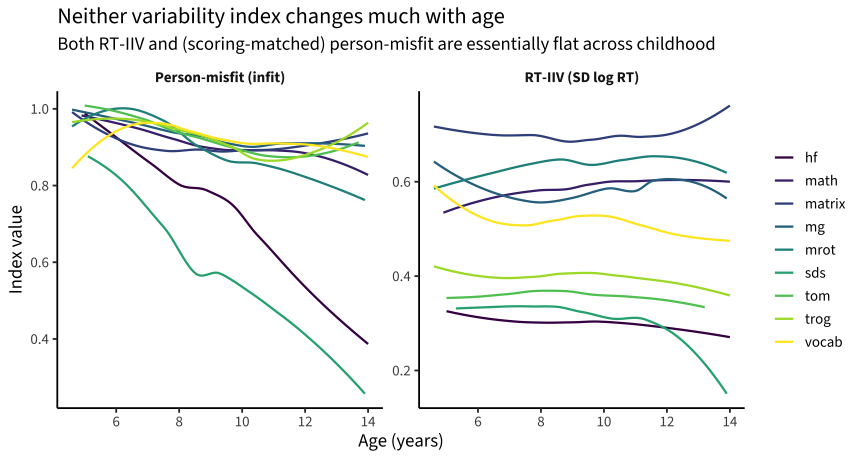
For each (reliable) index we regress on age — pooled across tasks with a task random effect — and plot the per-task trends.
Code
library(lme4)age_fit <-function(df, var, tasks){ d <- df |>filter(short %in% tasks, !is.na(.data[[var]])) m <-lmer(reformulate(c("age","(1|short)"), response = var), data = d)fixef(m)["age"]}slopes <-tibble(index =c("RT-IIV","Person-misfit"),per_year =c(age_fit(zi |>rename(v = iiv), "v", iiv_ok),age_fit(zi |>rename(v = infit), "v", infit_ok)))slopes |>mutate(per_year =round(per_year, 3)) |> knitr::kable(caption ="Age slope of each index (pooled, task random intercept; z-units & raw infit/IIV)")
Age slope of each index (pooled, task random intercept; z-units & raw infit/IIV)
index
per_year
RT-IIV
0.000
Person-misfit
-0.021
Code
bind_rows( zi |>filter(short %in% iiv_ok) |>transmute(short, age, value = iiv, index ="RT-IIV (SD log RT)"), zi |>filter(short %in% infit_ok) |>transmute(short, age, value = infit, index ="Person-misfit (infit)")) |>ggplot(aes(age, value, color = short)) +geom_smooth(method ="loess", se =FALSE, linewidth =0.8) +facet_wrap(~index, scales ="free_y") +scale_color_viridis_d(name =NULL) +labs(x ="Age (years)", y ="Index value",title ="Neither variability index changes much with age",subtitle ="Both RT-IIV and (scoring-matched) person-misfit are essentially flat across childhood")
With the scoring-matched IRF, neither index changes appreciably with age: RT-IIV is flat (pooled slope ≈ 0) and person-misfit nearly so (≈ −0.02/yr). The steep misfit-with-age decline seen under the mis-specified IRF was, again, an artifact of ignoring guessing — older/higher-ability children produced fewer “surprising” lucky guesses under the wrong model; once the model accounts for guessing, that age trend largely evaporates.
A first, honest pass — and the headline is a null on coherence:
The variability indices do not hang together. Within an index, cross-task generality is ≈ 0 (a child variable on math is no more variable on vocab); across indices, the three are mutually uncorrelated (|r| < 0.1). With naive estimators there is no general “variability trait” — within-task variability is overwhelmingly task-specific.
RT-IIV is the cleanest index but not (yet) a trait. It is reliably measured on most tasks (≈ 0.45–0.85) and is not an ability proxy (r ≈ −0.05) — but it is task-specific and flat with age. So it is a sound per-task measure whose cross-situational meaning is unclear here. (Followed up in depth in 07_rt_variability.qmd: purifying the RT signal and accounting for trial count surfaces a narrow speeded-task RT-IIV factor.)
Person-misfit, correctly specified, carries almost no usable signal. Once the response function matches the scoring model (fixed guessing at chance), infit is well-calibrated on every task (matrix included) and the ability-extremity confound disappears — but per-task reliability is ≈ 0, and the small surviving aggregate signal is still mostly inverse ability (r ≈ −0.52). It is not a usable individual-difference index here. (The earlier impression of reliable, age-declining misfit was an artifact of a mis-specified IRF — see §4.1.)
Growth-deviation is salvageable on some tasks. Two-wave reliability is moderate where growth is fast and well-measured (H&F 0.77, math 0.59, vocab 0.48) but poor elsewhere — usable in places, fragile overall.
How to read this: the null on coherence is partly substantive (these may genuinely be distinct, task-bound phenomena) and partly methodological — naive estimators are noisy and, for misfit, badly confounded, so any true common signal would be heavily attenuated. That is exactly the contingency the brief anticipated, and it motivates a model-based second pass: (1) replace naive infit with a guessing-aware person-fit statistic from the scoring model; (2) estimate individual growth as shrunken, error-propagating random slopes (and revisit as more waves arrive); (3) model RT-IIV with an explicit person×task variance-components model rather than per-run SDs; then re-ask whether — disattenuated — the indices cohere into a within-child variability construct.
4. Model-based upgrades
We keep the naive analyses above (we will always want those first-order views) and add the model-based versions here.
A note on guessing (corrected). The fitted scoring models do incorporate guessing: every item carries a fixed lower asymptote at its chance level (g = chance, not estimated) inside the mirt model — confirmed by reading the model records directly (matrix g = 0.25, mental-rotation 0.5, math per-item 0–0.5). score_irt passes the full mod2values() table — g rows included — into mirt(pars = …), so the released θ̂ already account for guessing. This was not obvious because the curated item_parameters table exports only difficulty and discrimination and silently omits g — a documentation gap worth flagging to the DCC, since anyone reconstructing the IRF from that table (as we first did) will get it wrong. The person-fit in §1 already uses the matching response function, P = c + (1 − c)·IRF; the check below shows why that is essential.
4.1 Why the person-fit response function must match the scoring model
Code
upg_mf <-map_dfr(core$task_id, function(tid){ rn <- runs |>filter(task_id == tid) tr <-load_levante_trials(task_ids = tid) |>filter(run_id %in% rn$run_id, !is.na(correct)) |>left_join(rn |>select(run_id, theta, language), by ="run_id") ipx <- ip |>filter(task_id == tid)if (tid %in% bylang) tr <- tr |>inner_join(ipx |>transmute(language = subset, item_uid, b = difficulty, a = discrimination), by =c("item_uid","language"))else tr <- tr |>inner_join(ipx |>transmute(item_uid, b = difficulty, a = discrimination) |>distinct(item_uid, .keep_all =TRUE), by ="item_uid") tr <- tr |>mutate(c =ifelse(is.na(chance), 0, chance), irf =1/(1+exp(-a*(theta-b))),Pn =pmin(pmax(irf, .001), .999), Pg =pmin(pmax(c + (1-c)*irf, .001), .999)) agg <- tr |>group_by(run_id) |>filter(n() >=10) |>summarise(naive =sum((correct-Pn)^2)/sum(Pn*(1-Pn)),guess =sum((correct-Pg)^2)/sum(Pg*(1-Pg)), .groups ="drop") |>left_join(rn |>select(run_id, theta), by ="run_id") sh <- tr |>group_by(run_id) |>filter(n() >=12) |>mutate(h =row_number() %%2) |>group_by(run_id, h) |>summarise(v =sum((correct-Pg)^2)/sum(Pg*(1-Pg)), .groups ="drop") |>pivot_wider(names_from = h, values_from = v, names_prefix ="h") r <-cor(sh$h0, sh$h1, use ="complete.obs")tibble(short = core$short[core$task_id == tid],`naive infit`=mean(agg$naive), `guess-aware infit`=mean(agg$guess),`naive vs θ`=cor(agg$naive, agg$theta, use ="complete.obs"),`guess-aware vs θ`=cor(agg$guess, agg$theta, use ="complete.obs"),`guess-aware reliability`=2*r/(1+r))})upg_mf |>mutate(across(where(is.numeric), \(x) round(x, 2))) |> knitr::kable(caption ="Plain-logistic (wrong) vs scoring-matched person-fit: calibration, ability link, reliability")
Plain-logistic (wrong) vs scoring-matched person-fit: calibration, ability link, reliability
short
naive infit
guess-aware infit
naive vs θ
guess-aware vs θ
guess-aware reliability
math
1.02
0.91
-0.38
-0.26
0.19
matrix
4.11
0.90
-0.60
-0.04
0.45
mrot
1.49
0.89
-0.68
-0.48
0.20
trog
0.93
0.92
-0.44
-0.35
-0.85
vocab
1.07
0.93
-0.53
-0.37
-0.44
sds
0.52
0.58
0.14
0.16
0.19
hf
1.51
0.75
-0.80
-0.79
0.45
tom
2.89
0.93
-0.66
-0.49
-0.24
mg
0.93
0.93
-0.24
-0.24
0.26
The comparison is a cautionary tale. The scoring-matched IRF (the one used in §1, with the fixed guessing asymptote) is well-calibrated — every infit mean near 1, matrix included. If instead you forget the fixed guessing and use a plain logistic — the “naive” column — infit inflates badly (matrix 4.2) and acquires a strong, spurious ability correlation, and a misleadingly high split-half “reliability” on the inflated tasks: the systematic guessing misfit is shared across both split-halves (lucky guesses cluster at low ability), so it looks like reliable between-child variance when it is really model mis-specification. Score “surprise” with the same response function the scores were fit under, and that apparent signal collapses — the scoring-matched misfit has ≈ 0 reliability. The lesson: person-fit is only meaningful against the exact IRF used to estimate θ̂. Done correctly, there is little real between-child variance in person-fit to measure here.
Random-slope LMM per task: reliable between-child slope variance is negligible
short
slope_sd
resid_sd
slope_reliability
trog
0.175
0.655
0.066
math
0.103
0.847
0.015
sds
0.070
0.653
0.011
mrot
0.068
0.694
0.009
hf
0.077
0.792
0.009
tom
0.036
0.600
0.004
vocab
0.029
0.597
0.002
mg
0.024
0.658
0.001
matrix
0.028
1.227
0.001
With only two waves the random-slope models are near-singular and recover negligible reliable between-child slope variance (slope reliability ≈ 0–0.06). This revises the optimistic naive 2-wave reliabilities above: those credited the EAP posterior SE as the only error term, but a model that lets occasion-to-occasion variance compete finds individual growth differences are not yet identifiable from two points. Growth-based variability needs ≥ 3 waves before it can be estimated per child.
4.3 RT-IIV as a variance-components model
Rather than a per-run SD, we model log RT-variability across all person×task runs and ask what share is a stable cross-task person property.
Variance decomposition of RT-variability (6647 runs, 1949 children)
component
variance_share
person (stable trait)
0.024
task
0.633
residual (person×task + noise)
0.344
Only ~4% of RT-variability is a stable cross-task person property; the bulk is task differences (~58%) and within-person/residual (~38%, which still includes measurement noise, so 4% is if anything an upper-ish bound on the trait share). The near-zero cross-task correlation in the naive analysis was therefore not merely attenuation — RT variability genuinely is task-specific, not a general trait, at these ages.
The model-based pass sharpens, and in one place corrects, the naive picture — and the verdict is a robust null on a general within-child variability trait:
Person-fit (scored against the model’s actual IRF — the fixed guessing asymptote the scoring already uses, not a new 3PL): well-calibrated on every task and free of the extremity confound, but ≈ 0 reliability — there is little real between-child variance to measure. The earlier “reliable, age-declining” misfit was an artifact of using the wrong (plain-logistic) response function.
Model-based growth: two waves cannot identify individual growth differences (slope reliability ≈ 0; models near-singular). The naive reliabilities were optimistic. Revisit at ≥ 3 waves.
RT-IIV variance components: a person×task model puts the stable-person share at ~4% — overwhelmingly task-specific.
Implication for LEVANTE. Measuring within-child variability as a coherent individual-difference construct will need richer designs, not better summaries of the current single-session scores: more longitudinal waves for growth, and within-task manipulations purpose-built to elicit and reliably capture variability (e.g., conditions that provoke lapses, speed–accuracy trade-offs). RT-IIV remains a clean, reliable per-task measure — it is simply not, on this evidence, a cross-task trait.